
You get into TV promo through broadcast contacts, talent agents who carry promo rosters, and the consultants who advise TV stations. Promo is an advanced area. Most promo voices build solid acting and commercial skills first. Then they train with promo coaches and land a one-off job before a station signs them for a year or longer.
Two full VO Journey Academy class replays, free. Put in your name and email and they play straight away.
Watch the free classesGabby Nistico teaches promo, and she came from broadcasting. On a recent live I asked her what promo really is today and how people get hired. A lot of it surprised me, and I do a fair amount of this work myself.
- In TV promo you become the voice of a station, usually on a yearly contract.
- Stations rarely change voices, so a good fit can last ten years.
- Promo is one of the few kinds of voice over work paid on a monthly retainer.
- News promo means being on call at any hour, so plan your life around the station.
- Most promo reads are under 20 seconds and timed to the second.
- Build your acting basics first, then train with promo coaches and make a promo demo.
What is TV promo voice over?
It's the voice that tells you what's coming up on a TV station or network.
Gabby calls promo a very unique part of voice acting. It only exists in television, for local stations and the national networks. When a station hires you, you become the voice of that station. It's contractual, and the contracts usually run year to year.
TV doesn't change voices very often. Once a station finds a voice it likes and has invested in it, it sticks with that person. There's a running joke in promo that once you're in, you might have a ten-year contract.
How do TV promo voice actors get paid?
Usually on a monthly retainer, and it pays well, even at the local level.
That's rare in voice over. Most of us never know when the next check is coming. With a retainer, you know that money arrives every month.
There's also a bonus at the start. When you replace another voice, the station sends an onboarding package. Gabby says that first job is often worth about ten times your monthly retainer. It covers years of recordings that now need your voice instead.
What are the golden handcuffs in promo?
It means you're paid well, but you're on call for the station.
How much depends on the station. A network that plans its promos weeks ahead is easy to live with. A news station is different. When big news breaks, they need you now. It can be any hour of the day or night. Gabby has heard many stories of promo voices leaving a full cart at the grocery store checkout. She's been one of them. Vacations take a lot of planning.
News promo voices may also record about three times a day. They do the morning promos at midday, the five o'clock promos around four, then the late news. The busier the news day, the busier you are.
“There's no such thing as a sleepy promo.”
Gabby Nistico, VO Journey Academy Live, 11 Nov 2026
What are the main types of TV promo?
Gabby breaks it into five, which match the main kinds of TV.
News and sports count as one. Then there's comedy and drama. The last two are documentary, which now includes true crime, and kids programming. A local station usually hires one voice to cover all of it. A national network might hire up to five voices, each with a specific purpose.
| Compare | Local station | National network |
|---|---|---|
| Who you voice for | One station, or many if a large company owns them | The whole network |
| What you voice | Usually every type of promo | Often one type, alongside other voices |
| How you're paid | Retainer, usually year to year | Retainer, usually year to year |
| What the work feels like | Fast and constant, especially news | Planned around the network's shows |
How long is a TV promo read?
Usually under 20 seconds for your part.
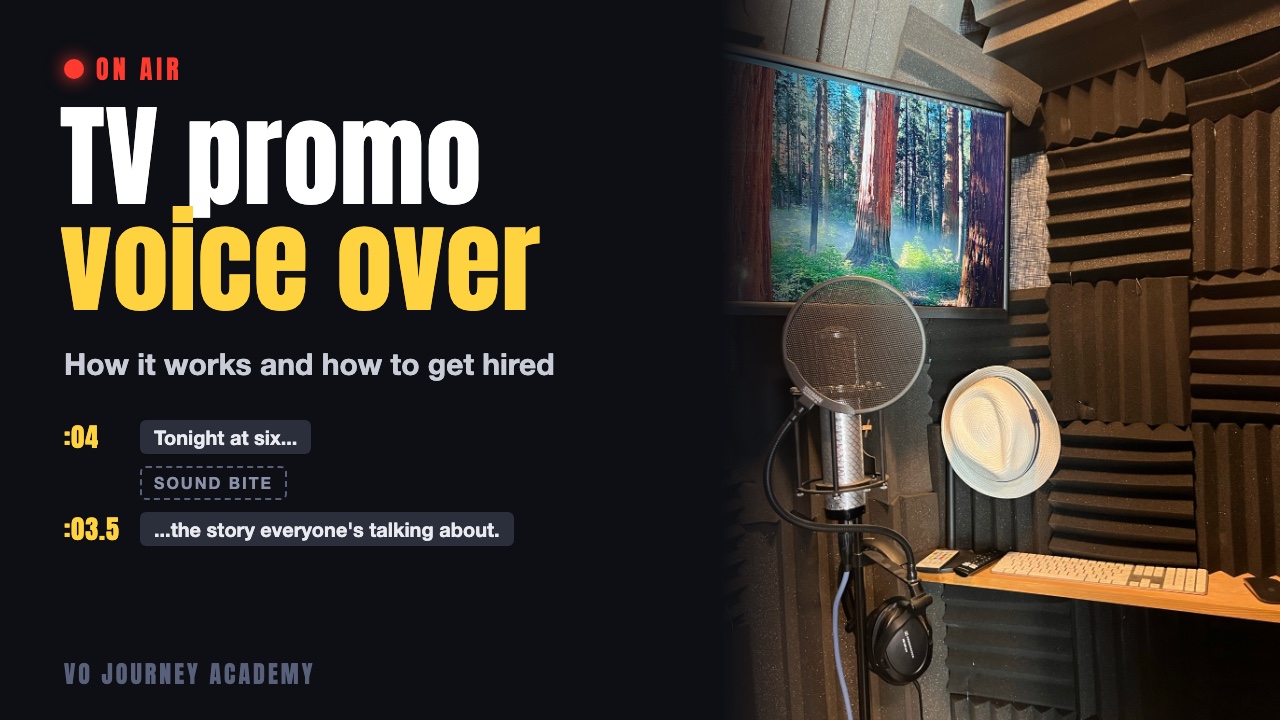
The finished spot might run 30 to 60 seconds once it's produced. Your voice over is often a small part of that. You'll also be timed to the line. A producer looks at the script and tells you to read this line in four seconds and that one in three and a half. If you want to practise, our script timer shows how long a script runs at your pace.
What makes promo hard to perform?
The copy is broken up, and you have to keep the energy up the whole time.
Gabby says broken-up copy is where her promo students spend the most training time. Your lines are split up by sound bites and video. For each line you have to decide whether the thought ends there or carries on after the clip.
And there's no such thing as a sleepy promo. Your body is engaged and there's tension in the read. You're setting a pace that makes people want to watch. Promo has more room to act than trailers do, but it's never passive.
Not sure which step you're on? Our four-stage path shows you what to do next, from setting up your studio to getting booked.
See where to startHow do you get hired for TV promo?
Through three main routes, according to Gabby.
The first is broadcasting contacts. Anyone with a broadcast background or friends in the business has a head start. The second is talent agents. A handful of agents specialize in promo and are known for carrying a promo roster. Getting onto those rosters matters if this is the work you want. More on how agents work in my post on whether you need a voice over agent.
The third is consultants. Stations pay consultants to audit them and make them more profitable. Contacting one station directly is hit or miss. A consultant advises many stations. Gabby says a running joke in broadcasting was that the consultant gets what the consultant wants.
Can a scratch read turn into a promo job?
Yes. Gabby says a lot of people break into trailer and promo from scratch reads.
A scratch read is a stand-in recording made before the final voice is brought in. It's often cheaper than paying a big name's rates during the early edits. I was once hired for a scratch track on a holiday movie trailer. You're always happy to be hired, even if you wanted the final one. Never look down on a scratch read.
How do you get experience for promo work?
Train with promo coaches, get involved in the industry, and take one-off jobs.
Promo clients like to see a solid training list. Gabby says some well-known promo coaches and workshops are close to mandatory, and some now run remotely. It's a small industry built on referrals, so get involved with its trade groups and events too.
Then look for one-off promo jobs. Stations hire them when they need a sound their regular voice doesn't have. They also hire them when the regular voice is away. That's why promo voices say never go on vacation. A substitute brings something new, and sometimes the station manager decides to keep them.
You'll also need a promo demo. If you've never made one, start with how to make your first voiceover demo.
Frequently asked questions
Is TV promo the same as movie trailers?
No, but there's a lot of crossover. Many trailer voices also do promo. Trailers you see on TV today are much shorter, and the voice often only comes in at the end.
Should a beginner go straight into promo?
Gabby and I both say no. Promo is an advanced area. Build your acting basics first. That foundation will make you better at promo later.
Does every TV station have a promo voice?
Yes. Mid-size markets and up usually have their own voice or voices. Many small stations are now owned by large companies, so one voice may cover many stations.
Where can I find promo scripts to practise?
We have free promo and trailer scripts in our script library. Practise reading to a set time.
What to do next
Pick three promo scripts and read each one to a strict time. Notice where the thought breaks and where it carries on. If you'd like feedback on reads like these, watch a free class. You can also watch the whole conversation with Gabby on the live.
Build the skills promo is built on
In VO Journey Academy you get live acting classes every week and feedback on your reads. Gabby Nistico and our coaches help you sound ready for advanced work like promo.
See the plansGo out there and audition.
Anthony
Anthony Pica, founder of VO Journey Academy