
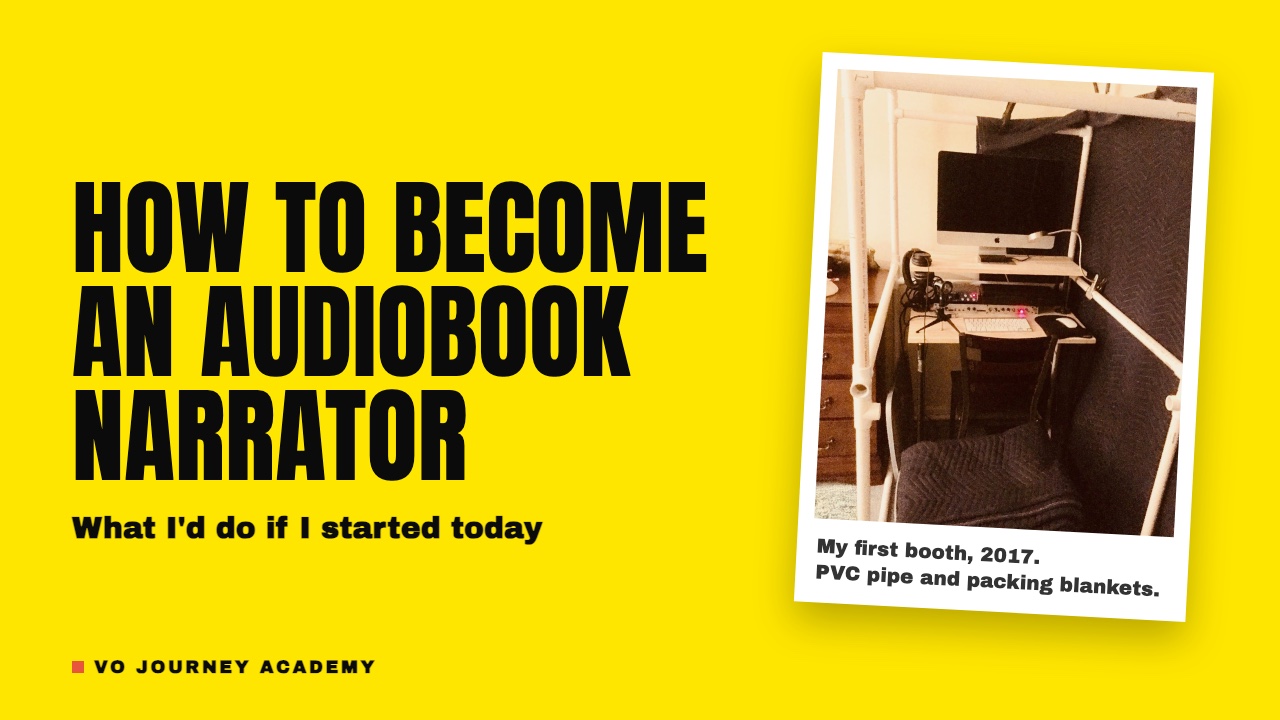
How to become an audiobook narrator from a guy who started in a packing-blanket fort. The acting, your space, auditions, how narrators get paid and more.
I narrated my first audiobooks while I was still working a full-time teaching job. I'd teach all day and record at night, and there were stretches where I was getting one or two hours of sleep and falling asleep at work. I don't recommend that part. I'm telling you because I want you to know where this started for me, and it wasn't anywhere fancy.
My first booth was a frame of plastic pipe with packing blankets thrown over it. I called it my "Hobo" fort. I didn't have much space at the time, so I put it up and took it down again every single night, and I recorded right next to the refrigerator (close quarters, trust me). My microphone was a $40 Blue Snowball, and I didn't even know what a pop filter was yet. I built my business in that hut.
Leave your email and we'll send you voice over practice scripts, with new ones every month.
Free. Unsubscribe any time. PrivacyToday our narrators have published over 750 audiobooks through Academy Voices. So when somebody asks me how to become an audiobook narrator, I've really got two answers. There's what I did, and there's what I'd do if I were starting today. This post is the second one.
Start with the acting
I always say that your gear and your studio are the icing, and your ACTING is the cake.
An audiobook is you, alone, holding someone's attention for hours. You're playing every character in the book, and you're also the person telling the story, and the listener has to believe all of them. That is acting, even when nobody can see you.
So before you worry about anything else, get used to reading out loud every day. Read a few pages of whatever book you're into and record it on your phone, then listen back. Can you hear where you rushed, or where you sounded like you were reading instead of talking to somebody? It still has to sound natural. That's the work, and it doesn't cost you anything.
When you want something built for practice, the audiobook section of our free scripts library has excerpts you can record and play back as many times as you like.
Find the quietest space you've got
You don't need a professional studio to start. You need the quietest space you have, and something soft around you so your voice isn't bouncing off bare walls. My packing-blanket fort did that job for years.
If I had to start over with the budget I had back then, I'd still build the fort. I'd just spend the money a little differently, and I'd learn the recording side a lot sooner than I did.
Because the other half of this is learning enough about recording and editing that your files come out clean. Audiobook platforms have technical requirements your files have to meet before a book can go live, and ACX publishes its own. If you use Adobe Audition, we have an older post on formatting your audio files for ACX.
Learn how audiobook auditions work
The usual way into your first book is auditioning. On ACX, rights holders (usually the author) post their books, and narrators audition from an excerpt.
The rules I teach for audiobook auditions are simple. Keep it to 2 to 3 minutes or less. Read the whole excerpt first, then find the best part and audition there. And always include a section with dialogue, because authors want to hear that you can handle it.
Then treat auditioning like something you can measure. Everybody has a number of auditions it takes them to book a job, and the only way to find yours is to keep track of every audition you send and every booking that comes from it. I wrote a whole post about that a couple of weeks ago, How Many Auditions Does It Take to Book a Voice Over Job. [NOTE: this link works once the 29 Sep post is live with the slug voice-over-audition-strategy. Publish in date order.]
Understand how narrators get paid
This is the part people are most confused about, so I'll keep it simple. There are two main ways.
Per finished hour means you're paid a rate for each hour of the finished audiobook, and that's the finished length of the book, not the hours you spent recording and editing it. With a new client on a per-finished-hour job, I always try to get 25 to 50% upfront once they've heard and approved the 15-minute sample.
Royalty share means there's no upfront fee, and you share in what the book earns over time instead. Most of the Academy Voices narrators are paid this way.
I'm not going to promise you a number here, because it depends on the book and on how much work you put in. If you want to see what rates look like across different kinds of voice work, our rate guide lays it out.
Get real books under your belt
Practice gets you ready, but at some point you need finished, published books with your name on them. That's the whole reason we built Academy Voices.
Every VO Journey Academy member gets free access to it. Our narrators record real audiobooks for real authors, with a coach's ear on the way there, and more than 190 narrators have published books through it so far.
Angela Ohlfest is a good example of where this can go. She came in as a VO Journey student, built a full-time voice business in under two years, and has narrated over 250 audiobooks. Now she runs Launch Pad, our Thursday night class for beginners.
Come see how we do it
It's Free Class Week right now, and our live classes are open to anyone through Thursday the 15th. Tonight at 8pm ET is Marketing 101. Wednesday night is Script Workout, which is never recorded, so it's a safe room to take risks. Thursday night is Launch Pad with Angela, which is the class new members start in.
Grab a free seat here. It's free. There's no card to enter and no sales call. And if you already know you want in, your first month of CORE is $39.
Go read something out loud today.
Anthony