30 scripts written by us, free to practice with, record and put in your reel.
Every one lists voice age, accent and length, so you can pick a read that fits the audition you are chasing.
Bouncing Letter B
Early reading, phonicsAdult (any, playful)Neutral AmericanOne narrator60 secondsabout 54s
Hi, reading friends! Today we're meeting a letter that loves to bounce. It's the letter B.
Say it with me: buh. Buh. Press your lips together, then let the sound pop out. Buh!
B is the first sound in ball. Ball. Can you hear it at the start? Buh, ball.
It's also the first sound in banana, bubble and bear. Let's say them slowly. Buh... banana. Buh... bubble. Buh... bear.
Now it's your turn to be a sound detective. I'm going to say three words. When you hear buh at the start, give a little bounce in your seat.
Ready? Bus.
[Pause]
Great bouncing! Next word: fish.
[Pause]
Hmm. No bounce for fish. Fish starts with fff. Last one: boat.
[Pause]
Bounce! Boat starts with buh. You found it. Tomorrow, B is bringing a friend.
What it is for: A phonics lesson that has to model a letter sound clearly while keeping a five-year-old engaged. Coach's note: Watch out for turning 'buh' into 'buhhh' with a big vowel on the end. Keep the sound short and clipped so kids copy it right. The pauses are for the child, so actually wait. What casting listens for: Casting listens for a teacher's clarity with a playmate's energy.
Counting Crabs at Low Tide
Early math, counting gameAdult (25-40)Neutral AmericanOne narrator30 secondsabout 28s
Down at the beach, the tide has gone out, and the crabs have come out to play.
Let's count them together. One crab under the rock. Two crabs by the shell. Three crabs digging in the sand.
Oh! Here come two more, walking sideways, of course. Three crabs and two more crabs makes... five. Five crabs!
Now tap each crab on the screen and count them again, nice and slow.
What it is for: A short counting activity that tests pacing: every number needs room for small voices to count along. Coach's note: Watch out for rushing the numbers. Kids are tapping the screen as you count, so give each crab its own beat. 'Sideways, of course' is a tiny aside with a smile. What casting listens for: Casting listens for patience and a light, smiling read.
Wendell and the Borrowed Light
Science for kids, astronomyAdult (any, playful)Neutral AmericanTwo narrators (duet)90 secondsabout 1.7 min
Cast: NARRATOROWL
NARRATORIt's late, and the forest is quiet. But up in the tallest pine, Wendell the owl is wide awake.
OWLOf course I'm awake. Owls work the night shift. And tonight I have a question for you. Look up. What do you see?
NARRATORThe moon! Big and round and bright.
OWLBright, yes. But here's a secret. The moon doesn't make any light of its own. Not one bit.
NARRATORThen how does it shine?
OWLIt borrows light from the sun. The sun shines on the moon, and the moon bounces that light down to us. Like a mirror in the sky. Hoo!
NARRATORBut Wendell, sometimes the moon is just a skinny little slice.
OWLAh, that's my favorite part. The moon is always a whole ball. But as it travels around the Earth, we see different amounts of its sunny side. When we see all of it, that's a full moon. When we see just a sliver, that's a crescent.
NARRATORSo the moon isn't really shrinking?
OWLNever. It's only turning its bright side toward us, a little more or a little less. It takes about a month to go through every shape, and then it starts all over again.
NARRATORTonight, before bed, peek out your window. What shape is the moon?
OWLDraw it in your moon journal. Tomorrow night, draw it again. Then you'll be a moon watcher, just like me.
NARRATORGoodnight, Wendell.
OWLGoodnight. Well... good morning, for me. Hoo.
What it is for: A two-hander where a warm narrator and a character owl explain moon phases through conversation. Coach's note: Watch out for the owl turning into a cartoon. Give Wendell a clear personality, maybe a little proud and a little sleepy, but let the facts land clean. The narrator asks the questions a child would ask, so keep them genuinely curious. What casting listens for: Casting listens for two distinct characters that still feel like they share one story.
Why Leaves Change Color
Science for kids, natureAdult (30-45)Neutral AmericanOne narrator60 secondsabout 60s
Have you ever noticed that in the fall, the trees start to change their clothes? Green leaves turn yellow, orange and even bright red.
But where do those colors come from?
All summer long, leaves are busy making food for the tree. To do that, they use something green called chlorophyll. There's so much green in each leaf that it covers up every other color.
When the days get shorter and cooler, the tree gets ready to rest for winter. It stops making all that green.
And as the green fades away... the yellows and oranges that were hiding underneath finally get to show. They were there the whole time!
Some trees make red colors too, right at the end of the season.
So next time you find a crunchy orange leaf, hold it up to the light. You're looking at a color that waited all summer for its turn.
What it is for: A calm science explainer for early grades that builds to a small 'wow' reveal. Coach's note: Watch out for explaining chlorophyll like a textbook. The big idea is that the colors were hiding there all along; that's the moment to slow down and let a little wonder in. What casting listens for: Casting listens for warmth and a sense of discovery, not a lecture.
Shape Sort Challenge
Early math, classroom appAdult (any, playful)Neutral AmericanOne narrator30 secondsabout 23s
Uh oh! The shape truck tipped over, and all the shapes spilled out.
Can you help put them back where they belong?
Circles go in the blue bin. Squares go in the yellow bin. And triangles go in the red bin.
Drag each shape into the right bin. If it wiggles, try another one.
Ready, set... sort!
What it is for: Game instructions that have to be crystal clear on the first listen, with a burst of fun at the end. Coach's note: Watch out for treating the rules like fine print. A four-year-old has to follow this, so each shape and each bin gets its own clear moment. What casting listens for: Casting listens for clarity first, then fun.
Welcome to the Dinosaur Hall
Museum audio guide, kidsAdult (35-55)Neutral AmericanOne narrator90 secondsabout 88s
Welcome to the Dinosaur Hall at the Brightwater Museum of Natural History. I'm glad you're here.
Before you go any further, stop right where you are. Now look up. Way up.
That long neck stretching over your head belongs to a dinosaur called Talusaurus. Her skeleton is as long as three school buses parked in a row. And she was a plant eater. All that size, and she spent her days munching on leaves at the tops of trees.
Scientists found her bones in a dry riverbed, one piece at a time. It took a team of twelve people four whole summers to dig her out. Every bone had to be wrapped in plaster, like a cast on a broken arm, so it wouldn't crack on the trip here.
Now walk around to her tail and look closely at the bones near the tip. Do you see how they get smaller and smaller? Some scientists think she could swing that tail fast enough to make a loud crack, like a whip, to scare away hungry predators.
Here's a question to talk about with your family. If you could ask Talusaurus one thing, what would it be?
When you're ready, follow the green footprints on the floor to stop number two, where you'll meet her much smaller and much sneakier neighbor.
What it is for: A family museum guide stop that has to hold kids' attention in a noisy room while giving parents real facts. Coach's note: Watch out for doing a spooky 'monster' voice on the big reveal. The drama comes from the numbers and the questions, not a growl. Leave space for kids to look up where you tell them to. What casting listens for: Casting listens for a storyteller who could keep a crowd of kids standing still.
Take all 30 kids education scripts with you
One printable sheet with every script on this page, ready to mark up in the booth. Leave your email and it opens
straight away, and we'll send you new scripts as we write them.
Welcome to Penguin Point at Cedar Hollow Zoo! Look through the glass, and you'll meet our colony of twenty-two penguins.
Penguins are birds, but they can't fly. Instead, they swim. Underwater, they flap their wings like they're flying through the sea, and they can zoom along faster than you can ride a bike.
On land, it's a different story. They waddle. Their legs are short, and their feet are set far back on their bodies, so walking takes a lot of wiggling.
Penguins have more feathers than you might think. They're packed in tight, like the shingles on a roof, to keep the cold water out and the warm air in.
See the penguin with the purple band on its wing? That's Pebble, our oldest penguin. She's nineteen years old and still the first one in the water at feeding time.
Feeding time is at two o'clock. Come back and watch her dive!
What it is for: An upbeat zoo exhibit narration that mixes fun facts with gentle direction for visitors. Coach's note: Watch out for piling on so much energy that every fact sounds the same. Let the funny fact about waddling have its own little lift, then settle for the facts about feathers. What casting listens for: Casting listens for enthusiasm with good variety.
Sleepy Solar System
Bedtime learning, spaceAdult (30-45)Neutral AmericanOne narrator2 minutesabout 1.8 min
Let's get cozy. Pull your blanket up to your chin, and take a slow breath in... and out.
Tonight we're going on a quiet trip through space. We'll visit each planet, one at a time, and say goodnight as we go.
First, we float past the sun. It's a star, a giant ball of glowing light, and it keeps all the planets warm.
Close to the sun is little Mercury. It's the smallest planet, and it zips around the sun faster than all the others. Goodnight, Mercury.
Next is Venus, wrapped in thick, cloudy air. It's the hottest planet of all. Goodnight, Venus.
Then comes a blue and green planet we know very well. That's Earth. That's home. Somewhere down there is your bed, and you're tucked inside it. Goodnight, Earth.
Now we drift past Mars, the red planet, dusty and quiet. Goodnight, Mars.
Here's Jupiter, the biggest planet, with swirly stripes and a great red storm that spins and spins. Goodnight, Jupiter.
Saturn floats by, wearing its beautiful rings made of ice and rock. Goodnight, Saturn.
Far, far away, Uranus rolls along on its side, like it's lying down for a nap too. Goodnight, Uranus.
And last of all, deep blue Neptune, the windiest planet, all the way at the edge. Goodnight, Neptune.
Now we turn around and float slowly home... past the rings... past the stripes... past the red dust... all the way back to Earth, and into your room, and into your bed.
The planets will keep turning all night long. You don't have to do a thing.
Goodnight, space. Goodnight, you.
What it is for: A bedtime learning read that teaches real facts while slowing the listener down toward sleep. Coach's note: Watch out for starting sleepy and staying flat. Begin in a soft but present voice, then let the pace and energy ease down planet by planet. By Neptune you should be close to a whisper, not a mumble. What casting listens for: Casting listens for a voice a child would want to fall asleep to, that still keeps every word clear.
Rhyme Time with Juniper
Early reading, rhymingAdult (any, playful)Neutral AmericanTwo narrators (duet)60 secondsabout 57s
Cast: NARRATORJUNIPER
NARRATORIt's Rhyme Time! And today, Juniper the fox is here to play.
JUNIPERHello, hello! I am excellent at rhyming. The best in the whole forest.
NARRATORLet's find out. Words that rhyme sound the same at the end. Like cat and hat. Juniper, what rhymes with cat?
JUNIPEREasy. Bat!
NARRATORYes! Cat, bat. What rhymes with dog?
JUNIPERHmm. Dog... Dog... Sandwich!
NARRATORSandwich? Let's listen. Dog, sandwich. Do they sound the same at the end?
JUNIPERNot even a little bit. I was testing you.
NARRATOROf course you were. Friends at home, can you help Juniper? What rhymes with dog?
Pause
JUNIPERLog! Frog! Fog! Oh, those are good ones.
NARRATORGreat rhyming, everyone. One more. What rhymes with sun?
JUNIPERRun! Fun! Bun!
NARRATORWow, Juniper. Three in a row.
JUNIPERTold you. Best in the forest.
What it is for: A two-voice rhyming game where one voice guides and a fox character plays along and gets it wrong on purpose. Coach's note: Watch out for making Juniper's mistakes sound like a real mistake. It's a joke, so Juniper should sound confident and a little cheeky. The narrator's corrections stay kind, never exasperated. What casting listens for: Casting listens for comic timing and a warm partnership between the two voices.
Hi there! Welcome to Story Cove, where every story is waiting just for you.
First, let's pick a buddy to read with. Will it be the turtle, the rabbit or the little blue whale? Tap the one you like best.
Great choice! Your buddy will help you with tricky words and cheer you on.
Now tap the big book, and let's read our very first story together.
What it is for: A first-launch welcome for a reading app that sets a friendly tone in a few lines. Coach's note: Watch out for sounding like a software announcement. This is the first voice a child hears in the app, so smile and speak to one kid, not a room. What casting listens for: Casting listens for instant friendliness.
[Line 1]
Great job! You did it!
[Line 2]
Wow, you got every single one right.
[Line 3]
Ooh, so close. Let's try that one again.
[Line 4]
That's okay! Mistakes help our brains grow. Give it another go.
[Line 5]
Level complete! You earned a gold star.
[Line 6]
You've been working hard. Want to take a little break?
[Line 7]
Welcome back! I missed you. Ready to keep going?
[Line 8]
Look at all those stars. You should be proud of yourself.
What it is for: A set of short in-app praise and retry lines, recorded as separate files. Trains variety across tiny reads. Coach's note: Watch out for reading every line the same way. Each prompt is its own moment; the retry lines need the most care, because a child who just got something wrong needs encouragement, not disappointment. What casting listens for: Casting listens for range across very short lines and a genuine, never sarcastic, 'try again'.
How Plants Drink
Science for kids, plantsAdult (25-40)Neutral AmericanOne narrator60 secondsabout 62s
Plants can't pick up a cup, so how do they drink?
Let's find out with a simple experiment. You'll need a glass of water, a few drops of food coloring and a stalk of celery with the leaves still on.
First, add the food coloring to the water. Blue works really well. Stir it around.
Next, stand the celery in the glass, leaves pointing up. Now comes the hard part. We wait.
[Time-lapse music]
After a few hours, look at the leaves. Do you see little lines of blue creeping up into them?
The celery pulled the colored water up through tiny tubes inside its stalk. Those tubes work a little like drinking straws. Real plants do this every day, pulling water from the soil up through their roots and stems, all the way to the tips of their leaves.
Try cutting the celery in half. Can you spot the blue dots where the tubes are?
What it is for: A classroom science video voiceover that walks through a simple experiment step by step. Coach's note: Watch out for losing the thread between steps. The experiment is the story, so make each step sound like it leads to the next. The result at the end deserves a small, real 'look at that'. What casting listens for: Casting listens for a clear guide who makes an experiment feel exciting.
Tens and Ones at the Bakery
Early math, place valueAdult (25-40)Neutral AmericanOne narrator90 secondsabout 83s
Welcome to Poppy's Bakery! Poppy makes the best muffins in town, and she has a clever way of keeping track of them.
Whenever she has ten muffins, she puts them in a box. One box always holds exactly ten. No more, no less.
This morning, Poppy baked a big batch. Let's count what she has on the counter.
She has two full boxes. Each box has ten muffins inside. So that's ten... twenty muffins in boxes.
And next to the boxes, she has three loose muffins that didn't fill up a box.
So how many muffins does Poppy have altogether? Two boxes of ten make twenty. Three loose ones make three. Twenty and three... twenty-three!
Here's the neat part. Look at the number twenty-three. The two tells us how many boxes of ten. We call that the tens place. The three tells us how many loose muffins. We call that the ones place.
Now it's your turn. Poppy just baked more muffins. She has four boxes and six loose ones. How many muffins is that?
[Pause]
Four tens are forty. Six ones are six. That's forty-six muffins! You're a place value baker.
Next time you see a number, ask yourself: how many boxes, and how many loose ones?
What it is for: A place-value lesson built around a story, where the math has to stay clear inside the fun. Coach's note: Watch out for letting the bakery story swallow the math. Every time you say 'box of ten' or 'loose ones', make it land, because that's the lesson. Numbers should be slow and exact. What casting listens for: Casting listens for a teacher who can tell a story without losing the point.
Where Does Rain Come From?
Science for kids, water cycleAdult (25-40)Neutral AmericanOne narrator90 secondsabout 86s
This is Drip. Drip is a drop of water, and right now, Drip is floating in a big, blue lake.
The sun comes out and shines down on the lake. It gets warmer... and warmer... and Drip starts to feel very light. So light that Drip rises up out of the lake and into the air, as a tiny bit of invisible water vapor.
That's called evaporation. Water warms up and turns into vapor.
Drip floats higher and higher, where the air is cold. Up here, Drip bumps into lots of other tiny drops, and they huddle together to stay close. Together, they make a cloud.
That's called condensation. Vapor cools down and turns back into drops.
The cloud gets bigger and heavier, full of drops like Drip. Soon it's too heavy to hold them all. And then... down they fall! Pitter, patter. It's raining.
That's called precipitation. Water falls from the sky as rain, or snow, or hail.
Drip lands on a hill, slides down into a stream, and rides the stream all the way back to the big, blue lake.
That's called collection. And then the sun comes out, and it all starts again.
The water you drink today might have been a cloud last week. It might even have been Drip.
What it is for: An animated water cycle explainer that follows one raindrop as a character in a story. Coach's note: Watch out for losing the four stages in a sing-song read. Evaporation, condensation, precipitation and collection are the lesson, so give each word space and say it clearly the first time. What casting listens for: Casting listens for storytelling that still teaches.
Sight Word Rocket
Early reading, sight wordsAdult (any, playful)Neutral AmericanOne narrator30 secondsabout 26s
Attention, astronauts! Your rocket needs fuel, and the only fuel it takes is words.
Every time you read a word out loud, the fuel tank fills up.
Here's your first word: the. Now say it with me. The.
Next word: and. Say it! And.
Last word: is. One more time. Is.
The tank is full! Buckle up. Five, four, three, two, one... blast off!
What it is for: A quick game read for a sight-word app with a countdown and a clear call to action. Coach's note: Watch out for letting the countdown speed up. The words 'the', 'and' and 'is' are the lesson, so say each one clearly even while the rocket is building up energy. What casting listens for: Casting listens for clean diction inside high energy.
Map Explorers: The Seven Continents
Geography for kidsAdult (25-40)Neutral AmericanOne narrator2 minutesabout 1.9 min
Grab your explorer hat. Today we're taking a trip around the whole world, and we're going to visit seven giant pieces of land called continents.
Look at the map. See the big shapes surrounded by blue water? Each one is a continent.
Let's start in North America. It stretches from icy lands in the far north all the way down to warm, sunny beaches. It has deserts, forests and some very tall mountains.
Just below it is South America. It's home to the Amazon rainforest, where it rains so much that more kinds of plants and animals live there than almost anywhere else on Earth.
Now we cross the ocean to Europe. Europe is small compared with the others, but it's packed with countries. Some of them are so close together, you could visit three in a single day.
Just south of Europe is Africa. Africa is huge. It has the longest river in the world and the biggest hot desert, too.
To the east is Asia, the biggest continent of all. More people live in Asia than on every other continent put together, and it has the tallest mountain on the planet.
Down in the bottom corner is Australia. It's the smallest continent, and it's the only place you'll find kangaroos hopping around in the wild.
And finally, at the very bottom of the world, is Antarctica. It's covered in thick ice all year long. Hardly any people live there, but lots of penguins do.
Let's count them together. North America. South America. Europe. Africa. Asia. Australia. Antarctica. Seven continents!
Which one do you live on? Put your finger on it. Which one would you visit first?
What it is for: A longer geography lesson that keeps momentum across a list of seven places. Coach's note: Watch out for reading it like a list. Each continent has one memorable fact; that fact is the thing to color. Vary the pace so Africa doesn't sound like Europe. What casting listens for: Casting listens for stamina and variety on list-based copy.
Down a quiet lane, past the old red barn, there's a place called Willow Farm. And on Willow Farm, when the sun goes down, the sheep all get ready for bed.
The farmer opens the gate to the sleeping meadow, and one by one, the sheep hop over the little wooden fence.
Let's count them as they go. Are you ready? We'll count softly, so we don't wake the chickens.
One sheep hops over. She's the fluffiest one, and she lies down right by the gate.
Two sheep hop over, side by side. They're sisters, and they always sleep close together.
Three... A little lamb, with a bit of hay stuck in her wool.
Four... slow and steady, the oldest sheep on the farm.
Five... he stops to look at the moon, then curls up in the grass.
Six...
Seven... yawning a great big yawn.
Eight...
Nine...
And ten. The very last sheep steps over the fence, turns around three times, and settles down with all her friends.
Ten sheep, all tucked in.
The farmer closes the gate. The moon rises over the barn. And everything on Willow Farm is quiet and still.
Goodnight, sheep. Goodnight, little lamb.
Goodnight.
What it is for: A bedtime counting story that combines gentle math with a slow wind-down. Coach's note: Watch out for keeping the same pace from the first sheep to the last. The count should get slower and softer as you go, as if you're getting sleepy too. What casting listens for: Casting listens for a grandparent-style warmth and control of pace.
Ask a Zookeeper: Giraffes
Zoo learning, Q and AAdult (25-40)Neutral AmericanTwo narrators (duet)2 minutesabout 2.0 min
Cast: HOSTZOOKEEPER
HOSTHi, everybody, and welcome to Ask a Zookeeper! Today I'm standing next to a very tall friend, and a very friendly zookeeper. This is Mara, who takes care of the giraffes here at Pine Valley Zoo.
ZOOKEEPERHi! And this tall friend is Juno. She's six years old, and she's about fifteen feet tall.
HOSTFifteen feet! That's taller than my house. We got a lot of questions from kids at home, so let's start. Owen, who's seven, wants to know: how much do giraffes eat?
ZOOKEEPERGreat question, Owen. Juno eats about seventy-five pounds of food every day. That's mostly leaves, hay and special giraffe biscuits. She eats for most of the day, actually.
HOSTNext question is from Lila. She asks, why do giraffes have such long necks?
ZOOKEEPERTheir long necks help them reach leaves at the very tops of trees, where other animals can't get to. But here's a surprise. A giraffe has the same number of neck bones that you do. Seven.
HOSTWait, really? Seven? Same as me?
ZOOKEEPERSame as you. Hers are just much, much bigger. Each one is about as long as your arm.
HOSTOkay, that's amazing. What about her tongue? I just saw it, and it's kind of purple.
ZOOKEEPERIt is! Her tongue is dark blue and purple, and it's almost two feet long. She uses it to wrap around branches and pull off the leaves. Some scientists think the dark color helps protect it from sunburn.
HOSTLast question, from Sam, who's five. Do giraffes sleep?
ZOOKEEPERThey do, but not very much. Juno sleeps only a few hours a day, and often she sleeps standing up.
HOSTStanding up! Thanks, Mara. And thanks, Juno.
ZOOKEEPERSay bye, Juno.
HOSTI think that was a yes.
What it is for: A two-voice interview for a zoo's kids' video series, with a curious host and an expert keeper. Coach's note: Watch out for the zookeeper sounding scripted. Keepers love their animals, so let the facts come out with pride and a few smiles. The host reacts honestly and doesn't over-perform the surprise. What casting listens for: Casting listens for natural back-and-forth and a real sense of two people in the same place.
Sometimes feelings get really big. Like when your tower falls down, or someone takes your turn, or you have to leave the park before you're ready.
Big feelings are okay. Everybody has them. Grown-ups too.
When a feeling gets big, your body might feel hot, or your hands might want to squeeze tight. That's your body telling you something important.
Here's something you can try. It's called balloon breathing.
Put your hands on your tummy. Now breathe in through your nose, slowly, and fill your tummy up like a big balloon.
[Pause]
Now let the air out through your mouth, nice and slow, like the balloon is floating away.
[Pause]
Let's do it one more time. Breathe in... and let it go.
How does your body feel now? Maybe a little calmer.
Your feeling might still be there, and that's all right. Now you can use your words to tell someone how you feel.
What it is for: A calming social-emotional lesson that models a breathing tool for kids with big feelings. Coach's note: Watch out for sounding clinical or preachy. You're sitting beside a child who is upset, so stay low, slow and kind. The breathing instructions need real time to happen. What casting listens for: Casting listens for calm, safety and zero judgment.
Coins in Your Pocket
Early math, moneyAdult (25-40)Neutral AmericanOne narrator60 secondsabout 61s
Let's empty our pockets and take a look at some coins.
This copper-colored coin is a penny. A penny is worth one cent.
This silver coin is a nickel. A nickel is worth five cents. That's the same as five pennies.
Now here's a tricky one. This little silver coin is a dime. It's smaller than a nickel, but it's worth more. A dime is worth ten cents!
So remember, bigger doesn't always mean more.
And this big silver coin is a quarter. A quarter is worth twenty-five cents.
Let's try a puzzle. You want to buy a sticker that costs fifteen cents. You have one dime and one nickel. Do you have enough?
[Pause]
A dime is ten cents. A nickel is five more. Ten and five make fifteen. You can buy the sticker!
Now open the coin jar on your screen and see how many ways you can make twenty cents.
What it is for: A money-counting lesson that has to make coin values stick for young learners. Coach's note: Watch out for blurring the coin names and values together. Penny, nickel, dime and quarter each need a clear pause, and the 'bigger isn't always more' point is the surprise. What casting listens for: Casting listens for a clear, friendly teacher's voice.
Telling Time with Tock
Early math, telling timeAdult (any, playful)Neutral AmericanTwo narrators (duet)90 secondsabout 1.5 min
Cast: NARRATORTOCK
NARRATORHanging on the classroom wall is a round, smiling clock named Tock.
TOCKTick, tock. Good morning! I'm Tock, and I tell everybody when it's time for lunch. Very important job.
NARRATORTock, can you teach us how to read a clock?
TOCKI'd love to. First, look at my face. See the numbers going around in a circle, from one all the way to twelve?
NARRATORGot it. And what about those two pointy arms?
TOCKThose are my hands. I have a short hand and a long hand. The short hand is the hour hand. It points to the hour.
NARRATORAnd the long hand?
TOCKThat's the minute hand. It moves faster and tells us the minutes. When the long hand points straight up to the twelve, we say o'clock.
NARRATORLet's try one. Tock, show us.
Clock hands move
TOCKMy short hand is pointing to the three. My long hand is pointing straight up to the twelve. So what time is it?
NARRATORThree o'clock!
TOCKRight! Now you try. My short hand is on the eight. My long hand is on the twelve.
Pause
NARRATOREight o'clock!
TOCKWonderful. One more, and it's a very important one. Short hand on the twelve. Long hand on the twelve.
NARRATORTwelve o'clock. Hey, isn't that...
TOCKLunchtime! Tick, tock. Told you it was an important job.
What it is for: A two-voice lesson where a friendly clock character helps a narrator teach hour and minute hands. Coach's note: Watch out for Tock turning into a noisy gimmick. A tick-tock here and there is fine, but Tock is a patient teacher underneath the silly voice. Keep 'short hand' and 'long hand' crisp every time. What casting listens for: Casting listens for a character voice that can still teach clearly.
A Caterpillar's Big Change
Science for kids, life cyclesAdult (25-40)Neutral AmericanOne narrator60 secondsabout 64s
On the underside of a leaf, there's a tiny egg. It's smaller than a grain of rice. And inside, something is growing.
One day, the egg cracks open, and out crawls a caterpillar. The very first thing it does? It eats its own eggshell. Then it starts on the leaf.
The caterpillar eats and eats and eats. It grows so fast that it gets too big for its skin, so it wriggles out and grows a new one. It does this again and again.
When it's finally big enough, the caterpillar hangs upside down and makes a hard, snug case around itself. This is called a chrysalis.
From the outside, it looks like nothing is happening. But inside, the caterpillar is changing. Its whole body is being rebuilt.
Then, after about two weeks, the chrysalis splits open. Out climbs a butterfly, with damp, crumpled wings.
It waits in the sun while its wings dry out. And then... it flies.
What it is for: A life-cycle lesson that builds naturally from small beginnings to a big finish. Coach's note: Watch out for rushing to the butterfly. The chrysalis is the quiet, mysterious part; slow down there so the ending feels earned. What casting listens for: Casting listens for gentle build and a sense of wonder.
Your Five Brilliant Senses
Science for kids, the human bodyAdult (30-45)Neutral BritishOne narrator90 secondsabout 1.5 min
Good morning, everyone. Today we're finding out about five brilliant tools you carry around with you all day long. And the best part? You've had them since the day you were born.
They're called your senses.
Your first sense is sight. You use your eyes to see. Look around your classroom and find something that's the colour green.
[Pause]
Well spotted. Your second sense is hearing. You use your ears to hear. Close your eyes for a moment and listen very carefully. What's the quietest sound you can hear?
[Pause]
Your third sense is smell. You use your nose to smell. Your nose can tell you when your tea is nearly ready, or when something is burning, which is very useful.
Your fourth sense is taste. You use your tongue to taste. Your tongue can tell the difference between sweet, salty, sour and bitter. Think about a lemon. Is your mouth going a bit funny? That's sour.
And your fifth sense is touch. You feel things with your skin, all over your body. Rub your hands together. Are they getting warm?
So that's sight, hearing, smell, taste and touch. Five senses, working together, all the time.
Here's your challenge for playtime. Find one thing that's smooth, one thing that's rough, and one thing that makes a noise. Then come back and tell a friend which senses you used.
What it is for: A British-accent primary school lesson that invites children to use each sense as it's introduced. Coach's note: Watch out for racing through the list. Each sense comes with a small task, so pause to let the class actually do it. Keep the tone bright but grounded, like a favourite teacher. What casting listens for: Casting listens for a natural British classroom warmth.
Gallery Scavenger Hunt: Ancient Egypt
Museum learning, activity guideAdult (25-40)Neutral AmericanOne narrator60 secondsabout 63s
Welcome, young explorers, to the Ancient Egypt Gallery. Your mission today is to find three hidden treasures. Are you ready?
Treasure number one: somewhere in this room is a cat. Not a real cat, but a cat made of bronze, sitting very tall and proud. The ancient Egyptians loved cats so much, they made statues of them. Can you find it?
Treasure number two: look for a long, painted box shaped like a person. It's called a coffin, and the pictures on it tell a story. Count how many birds you can find painted on the side.
Treasure number three is the trickiest. Find a small stone carved like a beetle. It's called a scarab, and people wore them for good luck.
When you've found all three, head to the front desk and whisper the secret word: scarab. There might be a sticker waiting for you.
Now go. And don't tell the grown-ups where the cat is.
What it is for: A self-guided museum activity read that sends kids around a gallery with clear missions. Coach's note: Watch out for sounding like a quiz host. It's a treasure hunt, so play it like a secret mission, a little hushed and conspiratorial, especially on 'don't tell the grown-ups'. What casting listens for: Casting listens for playful mystery and very clear instructions.
Handwashing Heroes
Health for kidsAdult (25-40)AustralianOne narrator30 secondsabout 28s
G'day, Handwashing Heroes! Germs are tiny, sneaky and way too small to see. But you can wash them away.
Here's how. Wet your hands. Add some soap. Now scrub, scrub, scrub, the fronts, the backs and in between your fingers.
Keep scrubbing while you sing the alphabet song all the way through.
Then rinse off the bubbles and dry your hands on a clean towel.
Germs gone. Hero done!
What it is for: A quick, bouncy Australian health spot for classrooms that has to teach steps in order. Coach's note: Watch out for letting the fun bury the steps. Wet, soap, scrub, rinse, dry: each one gets its own clear beat. What casting listens for: Casting listens for a natural Australian brightness and clear sequencing.
Coding with Bolt the Robot
Early coding, classroom appAdult (25-40)Neutral AmericanOne narrator2 minutesabout 2.0 min
Meet Bolt. Bolt is a little robot who lives on a grid of squares, and Bolt is very, very hungry for apples.
But there's one thing you need to know about Bolt. Bolt can't think for itself. Bolt only does exactly what you tell it to do. Nothing more, nothing less.
The instructions we give a robot are called code. And today, you're going to write some.
Look at the grid. Bolt is standing on the green square. The apple is three squares ahead. What should Bolt do?
Let's try it. Tap the arrow that says forward. Tap it once.
[Robot beeps]
Bolt moved forward one square. But the apple is still two squares away. So we need more forward steps. Tap forward two more times, then press go.
[Robot beeps three times]
Yum! Bolt got the apple. You just wrote your first piece of code!
Now let's make it trickier. In level two, the apple is around a corner. Bolt needs to go forward two squares, then turn right, then go forward one more square.
What happens if we forget the turn?
[Robot bumps]
Oops. Bolt walked straight into the wall. Robots don't guess. If you forget a step, the robot will just keep doing what you told it, even if it bumps into something.
When code doesn't work the way we planned, programmers call it a bug. And fixing it is called debugging. Every coder in the world makes bugs. Even the grown-up ones. Especially the grown-up ones.
So let's debug. Add the turn right arrow after the two forward steps, then press go.
[Robot beeps]
There it goes. Forward, forward, turn, forward. Apple!
Great job, coder. Order matters. Every step matters. And when something goes wrong, you look carefully, find the bug and try again.
Bolt's still hungry. Ready for level three?
What it is for: An early coding lesson that introduces instructions and sequencing through a robot character. Coach's note: Watch out for talking down to kids or overexplaining. The big idea is simple: robots only do exactly what you tell them. Let the robot's mistake be funny, then make the lesson clear. What casting listens for: Casting listens for clarity, patience and a little bit of fun.
The Seed That Waited
Bedtime learning, storyMature (55+)Neutral AmericanOne narrator2 minutesabout 1.9 min
Once, in a garden at the edge of a small town, a girl named Rosie planted a seed.
It was a tiny, brown seed, no bigger than a freckle. Rosie pressed it into the soft dirt with her finger, covered it up, and gave it a drink from her yellow watering can.
The next morning, she ran outside to see her flower.
But there was nothing. Just dirt.
The seed, deep down in the dark, wasn't worried. It was busy. It had soaked up the water Rosie gave it, and it was getting ready. Very, very slowly, a tiny root began to push down into the ground, looking for more water.
Rosie came back the next day. Still nothing.
And the day after that. Nothing.
But every day, she gave the seed a drink. And every day, underneath, the seed kept working. Its root grew longer. And then, a little green shoot began to push up, up, up, toward the warm light it could feel above.
On the eighth morning, Rosie knelt down by the garden and gasped.
There, poking out of the dirt, was a tiny green sprout with two small leaves, like two hands waving hello.
Rosie kept watering. The sun kept shining. The sprout grew taller, and it grew more leaves, and one day at the very top, a round green bud appeared.
And one warm morning, the bud opened, and there it was. A yellow flower, as bright as Rosie's watering can.
Rosie smiled. Her flower had been growing the whole time. She just couldn't see it yet.
Some things grow quietly, where no one can see. Like seeds. And like you, while you sleep.
Goodnight.
What it is for: A bedtime story that teaches how seeds grow while carrying a quiet lesson about patience. Coach's note: Watch out for making the moral obvious. The story does the teaching, so don't lean on the last line. Keep the whole read soft and unhurried, with the most warmth on the seed's small moments. What casting listens for: Casting listens for a gentle storyteller with a sense of rhythm.
Weather Watchers
Science for kids, weatherAdult (25-40)AustralianOne narrator60 secondsabout 65s
Hey, Weather Watchers! Scientists who study the weather are called meteorologists. And this week, you're going to be one.
Every morning, before class starts, head outside and look up at the sky. Then grab your weather diary and draw what you see.
If the sun's out and there are no clouds, draw a big yellow sun.
If there are a few clouds, draw a sun peeking out from behind one.
If the whole sky is grey, draw a big grey cloud.
And if it's raining, add some raindrops falling down.
Now check the flag on the school flagpole. Is it hanging still, or flapping about? If it's flapping, it's windy, so draw some wavy lines.
At the end of the week, look back at your diary. Which kind of weather did you see the most? Did the weather change a lot or stay the same?
That's exactly what real meteorologists do. They watch, they write it down, and they look for patterns.
What it is for: An Australian-accent classroom science segment that teaches kids how to keep a simple weather diary. Coach's note: Watch out for letting the accent turn into a caricature. Keep it natural and relaxed, with clear instructions for each weather symbol. What casting listens for: Casting listens for an easy, natural Australian voice kids would trust.
Vowel Sounds Warm-Up
Early reading, phonics reviewAdult (25-40)Neutral AmericanOne narrator90 secondsabout 1.5 min
It's time for our vowel warm-up! Stand up tall, stretch your arms up high, and get your mouth ready.
There are five vowels in the alphabet: A, E, I, O and U. Today we're practicing their short sounds. Let's go one at a time.
The first vowel is A. Its short sound is ah. Open your mouth wide, like you're at the doctor. Ah. Ah, like in apple. Ah, apple.
The next vowel is E. Its short sound is eh. Eh. Eh, like in egg. Eh, egg.
Next comes I. Its short sound is ih. Ih. Ih, like in itch. Scratch your arm if you're itchy! Ih, itch.
Then O. Its short sound is aw. Make your mouth round, like a little O. Aw. Aw, like in octopus. Aw, octopus.
And the last vowel is U. Its short sound is uh. Uh. Uh, like in up. Point up! Uh, up.
Now let's put them together, nice and fast. Ah, eh, ih, aw, uh.
One more time, even faster. Ah, eh, ih, aw, uh!
Great work. Now let's play a game. I'll say a word, and you tell me which vowel sound is in the middle.
Cat.
[Pause]
Ah! Cat has the ah sound.
Pig.
[Pause]
Ih! Pig has the ih sound.
Sun.
[Pause]
Uh! Sun has the uh sound.
You're vowel experts. Take a seat, and let's get reading.
What it is for: A phonics review where exact, consistent vowel sounds are the whole job. Coach's note: Watch out for sliding into long vowel sounds by mistake. These are short vowels, so keep them short and pure, and say each one exactly the same way every time you repeat it. What casting listens for: Casting listens for precision, consistency and encouragement.
Welcome to Practice Mode in Spelling Hive. I'll say a word, use it in a sentence, and then say it again. Type the spelling in the box. Take your time. There's no timer in practice mode.
Here's your first word.
Garden. We planted tomatoes in the garden. Garden.
[Pause]
Nicely done. Next word.
Because. I wore my raincoat because it was raining. Because.
[Pause]
Good try! Because is a tricky one. It's spelled B-E-C-A-U-S-E. Let's come back to it at the end.
Next word.
Friend. My friend sat next to me at lunch. Friend.
[Pause]
Correct! Remember, friend has an I before the E.
Last word for this round.
Whistle. The coach blew her whistle. Whistle.
[Pause]
That's right. The T in whistle is silent. Sneaky.
Round complete. You spelled three out of four. Let's try because one more time.
What it is for: An in-app spelling practice script with the structure of a real spelling bee: word, sentence, word. Coach's note: Watch out for rushing the target words. Every spelling word is said slowly and clearly, the same way each time, and the example sentence is natural, not sing-song. What casting listens for: Casting listens for an even, trustworthy host voice with precise diction.
Reading alone only gets you so far
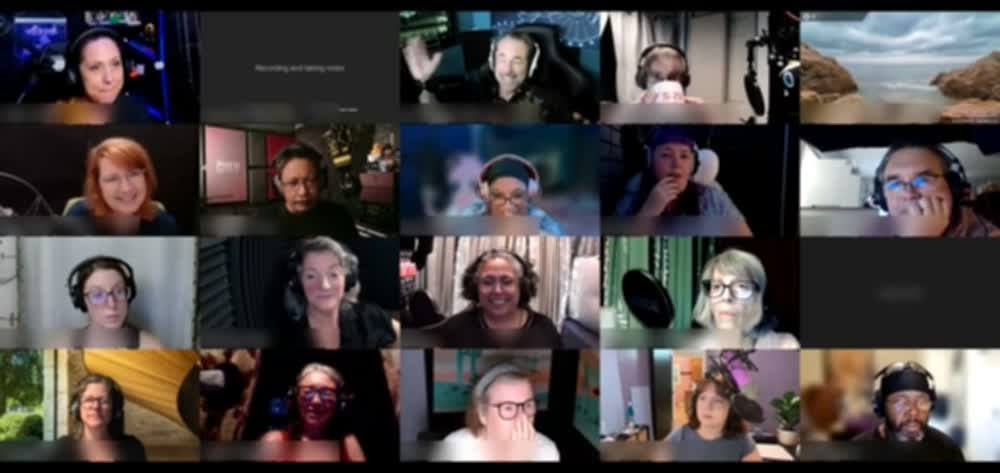
Members bring scripts like these to class every week and get feedback on the spot, from working coaches.
Use these freely. Every script here was written by VO Journey Academy.
Practice with them, record them, post them as demos, reels or social clips, and use them in auditions.
Please do not resell them or publish them as your own scripts. A credit is always welcome, never required.