
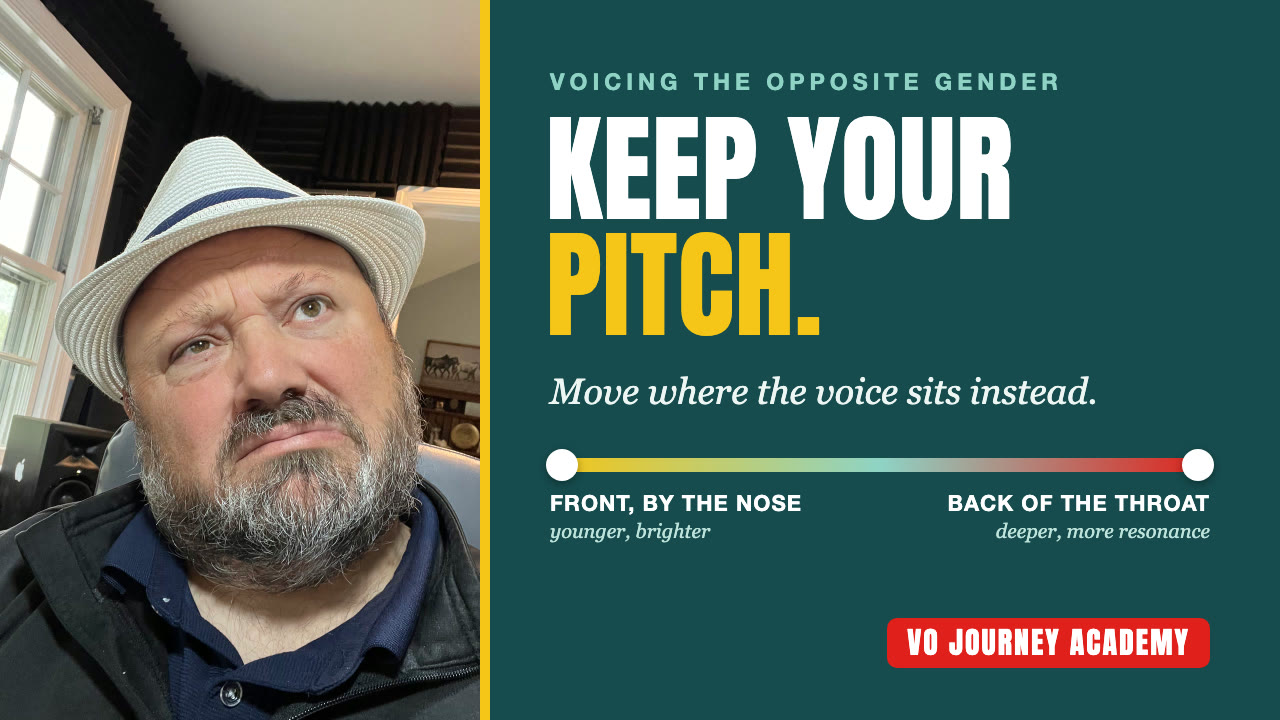
Leave your pitch alone. When a man raises his voice to play a woman, or a woman drops hers to play a man, it almost always sounds silly. Change the tempo and the breath instead. Then move where the voice sits in your mouth, from up by your nose to the back of your throat.
Practice your female and male characters on real scripts from our free audiobook script library.
Get the free scriptsGabby Nistico and I got this question on our Open Forum Friday live. If you had to voice a woman for a few sentences, would you change your pitch or your tempo? I love this question, because almost every narrator runs into it.
- Don't start with pitch. A big pitch change sounds amateurish unless the piece is meant to be over the top.
- Use tempo and breath first. Female voices tend to be a little breathier than male voices.
- Do a little less. Going big turns a character into a caricature, and that turns off your audience.
- Subtlety is everything. A tiny shift in volume or attitude can be enough.
- Push the voice forward toward your nose to sound younger.
- Push it to the back of your throat and open up to sound deeper, with more resonance.
- Tighten the throat at the back for a raspy smoker's voice.
Should you change your pitch to voice the opposite gender?
Almost never.
There's only a tiny number of situations where I'd change the pitch of my voice. When a man does that and says "I'm a girl," he doesn't sound like a girl. It also makes the read sound amateurish and silly.
The same goes the other way. A woman pushing her voice down to "do a man" sounds strange and farcical.
The one exception is a piece where the characters are meant to be over the top. If it's meant to be that extreme, then a pitch change is okay. Otherwise, I'd leave it alone.
What should you change instead?
Tempo and breath.
There are other modes of expression besides pitch. Tempo is one. Breath is a great one. Female voices tend to be a little breathier than male voices, so that's an easy way to start telling characters apart.
How does a woman voice a man?
The same way. Do a little less.
Gabby said this, and Angela Ohlfest said it on our Thursday live too. Everybody wants to do more. Everybody wants to do something big and interesting. The problem is that it becomes a caricature, and that really turns off your audience. It wasn't your intention, but it's what happens.
“Everybody wants to do more, do something interesting, do something big. But honestly, the problem is it becomes a caricature.”
Gabby Nistico, VO Journey Academy Live, 6 Nov 2026
Gabby's answer is subtlety. It could be a tiny shift in pitch or a tiny shift in volume. It could even be an attitude change. Focus on what makes the character who they are. Think about their demeanor and their body language, and act it.
Where should the voice sit in your mouth?
Wherever it gives you the sound you need. Moving it changes the sound without you forcing the pitch.
If you have a lot of characters in a book, it's up to you to give each one a slightly different sound. One physical way to do that is where you place the voice.
Right now I talk from the middle to the back of my throat. I used to talk from the front, and it was very nasal. Being a voice actor is what pushed me to move my voice back.
When I push it forward, my pitch does go up a little. I'm not raising it on purpose, though. It's coming from where I've placed it in my mouth.
See how our coaches give notes on a read like this. Two full class replays play straight away.
Watch now, freeHow do you sound younger without raising your pitch?
Push the voice forward, toward your nose.
If I want to sound younger, I bring it forward in my mouth, toward the front of my nose. You get a little whiny quality. That's how I used to talk all the time.
When I go back and push it to the back of my throat, you hear the difference. You get more resonance, more bang for your buck.
How do you sound deeper or older?
Open your throat and yawn.
People think you have to constrict yourself to speak. Open your throat instead. If you're trying to bring your voice down, yawn. Open your mouth and yawn.
Gabby said she'd never heard that one before.
For a character who smokes, try the opposite. Push the voice to the back of your throat, but tighten it there instead of opening it. That gives you the raspy voice.
| What you change | What it does | When to use it |
|---|---|---|
| A big pitch change | Usually sounds silly and amateurish | Only when the piece is meant to be over the top |
| Tempo | Sets a character apart without forcing the voice | Any time |
| Breath | A little more breath reads as more feminine | When a man voices a woman |
| Attitude and demeanor | Shows who the character is | Every character |
| Forward, by the nose | Younger, a little whiny | Young characters |
| Back of the throat, open | Deeper, more resonance | Older or deeper characters |
| Back of the throat, tight | Raspy | A smoker, a rough voice |
Why does it go cartoony so fast?
Because it doesn't take much.
Gabby put it well. People don't realize how easy it is to go from something that sounds amazing to something cartoony. And it happens really fast.
None of my examples on the live came from me trying to change my pitch. You can hear some pitch changes, but the placement brought them on naturally. That's the difference between a character and a caricature.
Frequently asked questions
Should a man raise his pitch to voice a woman in an audiobook?
Almost never. It tends to sound amateurish and silly. Use tempo and a little more breath, and let the acting carry it.
How does a woman voice a male character?
Do a little less. Don't push your voice down to "do a man." Change the attitude and demeanor, and let a small shift in placement do the rest.
How do I make my voice deeper for a character?
Push the voice to the back of your throat and open your throat. A yawn is a good way to feel that open space.
How do I sound younger for a child or teen character?
Bring the voice forward in your mouth, toward your nose. Your pitch may rise a little on its own, and that's fine.
When is a big pitch change okay?
When the piece is meant to be over the top, like a broad, cartoony character. For most audiobooks, keep it subtle.
What to do next
Watch the full answer from the live. Then play around with it. Take one scene with a man and a woman talking, and try tempo, breath and placement before you touch your pitch.
Get notes on your characters
We have live classes every week where you read, a coach gives you a note, and you read it again. Every plan includes Academy Voices, our alternative to ACX.
See the plansGo out there and audition.
Anthony
Go out there and audition.
Anthony
Anthony Pica, founder of VO Journey Academy