
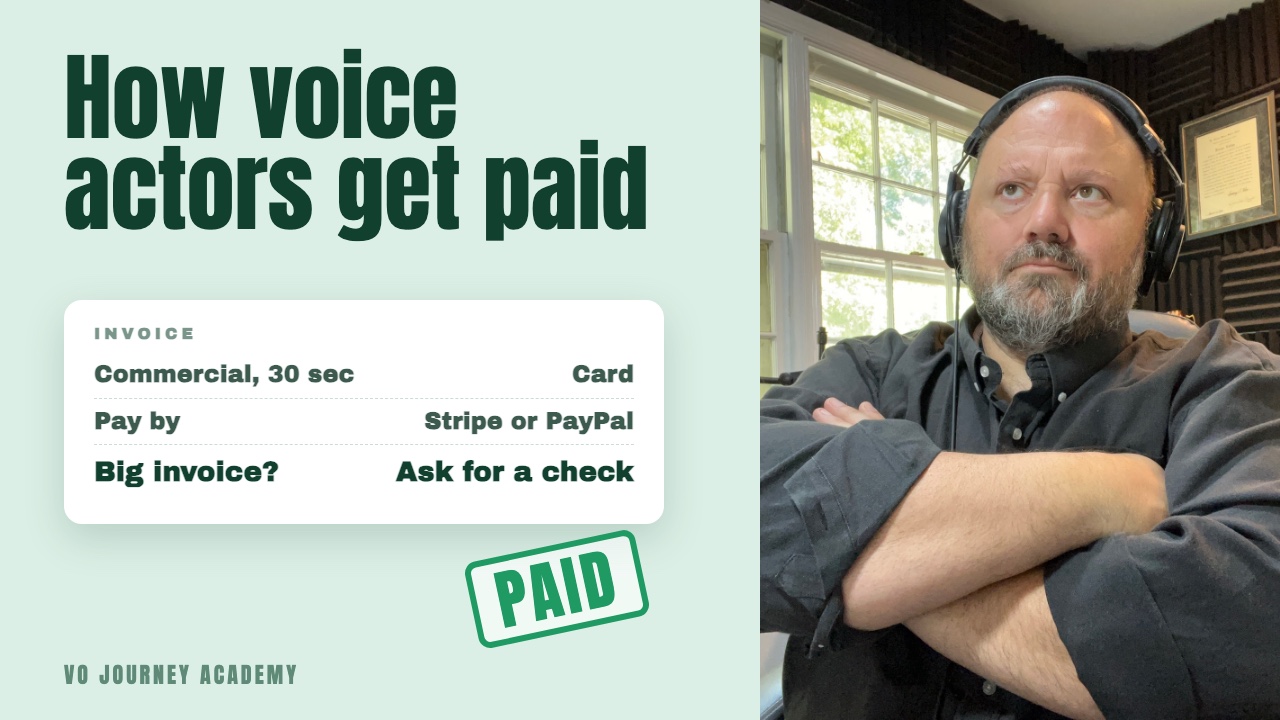
Most voice actors get paid online. Clients pay by card through a service like Stripe or PayPal, and the money lands in your bank account. Fees usually run about 1.5 to 4 percent per payment. On a big invoice, ask for a check instead so you don't lose hundreds of dollars to fees.
Two full VO Journey Academy class replays, free. Put in your name and email and they play straight away.
Watch the free classesOn an Open Forum Friday live, a viewer asked how to set up Stripe. He just wanted to accept payments and was surprised how complicated it looked. Gabby Nistico runs her own voice over business and handles a lot of client billing, so I handed it to her. This post is her answer, plus how we both do it.
- You need an online payment account. Skip the card readers.
- Setting up Stripe or PayPal takes one afternoon, mostly bank verification.
- Fees run about 1.5 to 4 percent, or a small minimum fee per payment.
- Accept as many payment methods as you can. Make it easy to pay you.
- On a large invoice, a paper check can save you a lot in fees.
- Overseas clients and currency conversion need their own plan.
What's the easiest way for clients to pay a voice actor?
A payment link or invoice they can pay by card.
Gabby's rule is to reduce the barriers to payment. Your client should be able to pay you quickly, in the way they already use. The faster it is for them, the faster the money reaches you.
Most of our clients pay by card through Stripe. Plenty still prefer PayPal, so we both keep that open too. Gabby goes further and says to have every option you can. That includes apps like Venmo and Cash App if your clients ask for them. Losing a job because you don't take the way someone pays would be a painful way to lose work.
Why does Stripe look so complicated?
Because a lot of it is built for shops, and you don't need that part.
Gabby explained where the confusion comes from. Companies like Stripe and PayPal sell a lot of point of sale gear. That's the card reader or kiosk a shop uses when someone taps a card at the counter. When you visit their sites, they push all of that at you.
A voice actor runs a service business. Your clients pay you from a distance, so you only need virtual payments. You need the account itself and nothing else.
How do you set up Stripe as a voice actor?
Make the account, verify your bank, then connect it to how you bill.
Gabby says setup is a bit of a pain, but you only do it once. The main step is bank verification. Stripe needs your bank account and routing number, and your business tax ID if you have a registered business. Once the bank side is verified, the two accounts link.
After that, you connect Stripe to whatever you use to bill people. That might be your invoicing tool or a pay button on your website. Your clients can then pay by debit or credit card, and the money goes to your bank.
“Your job as a business owner is to reduce the barrier to payment.”
Gabby Nistico, VO Journey Academy Live, 13 Nov 2026
How much do payment fees cost?
Usually 1.5 to 4 percent of the payment, or a small minimum fee.
Gabby says the prices are fairly standard across the big companies. Some charge a percentage of each payment. Others charge a flat minimum of a few dollars per transaction. It's worth comparing before you choose, but the difference is usually small. Your own bank may also offer its own way to take card or online payments now, so check there too.
| Method | Good for | Watch out for |
|---|---|---|
| Stripe | Card payments through an invoice or a pay button | Setup takes bank verification |
| PayPal | Clients who already use PayPal, which is a lot of them | Fees on every payment |
| Venmo, Cash App, your bank's own options | Smaller jobs and clients who ask for them | Check each one's fees and limits |
| Wise | Clients who pay in another currency | It's a separate account to set up |
| Check or bank transfer | Large invoices where fees would add up | Slower to arrive |
When should you ask for a check instead?
When the invoice is big enough that fees would hurt.
Gabby takes card payments for almost everything. The one time she says no is a large invoice. If a percentage fee would cost her a couple of hundred dollars, she asks for a paper check or a direct bank transfer instead. On a small job the fee hardly matters. On a big one it adds up fast, so do the maths before you send the invoice.
How do you get paid by clients in other countries?
Look at Wise, and get advice on tax before you sell overseas.
For clients paying in a different currency, Gabby recommends Wise. It's built for currency conversion and international payments. We also use Stripe on our own store to sell worldwide. That takes some extra setup to handle different countries.
Tax is the other part. When you sell to people in other countries, some of them charge sales tax on what you sell, such as value added tax in Europe. The rules and limits vary a lot by country. Have your bookkeeper or accountant handle it, or use a service that does it for you for a slightly higher fee. It's worth the money.
Not sure which step you're on? Our four-stage path shows you what to do next, from setting up your studio to getting booked.
See where to startDo online payments really get you paid faster?
Yes, and they cut down on late payments.
Gabby still enjoys her walk to the mailbox to see what checks have come in. But a paper check takes days to arrive and clear. Online payments skip most of that. She also finds that late payments are much less common since most of her clients started paying online. I've found the same.
Watch out for the other side of this, though. A fake job will sometimes send a check for more than the fee and ask you to send the difference back. That's a scam. I wrote about how to spot fake voice over jobs and get paid safely.
Once you can take payments, how do you find clients?
Reach out to them. They don't know you exist until you do.
Another viewer asked if it's OK to send your demos to production houses and casting companies. Gabby said yes, of course. They're major buyers of voice over work. First, check their website. Many have specific instructions or a separate email for talent. If not, keep your message short. Send links, not attachments. Don't fill their inbox with big audio files.
I do this too. Social media helps, but reaching out directly is how most people will find out you exist. I don't mind when people reach out to me to offer a service. How else would I know about them?
Frequently asked questions
Do I need a business account to take payments?
Not always. Stripe asks for your business tax ID if you have one. Many people start with their own name and bank account, then set up a business later. Ask your accountant what makes sense where you live.
Is Stripe or PayPal better for voice actors?
We both like Stripe the most. It's easy to use, and banks trust it. But keep PayPal too, because a lot of clients pay that way.
How do audiobook narrators get paid?
Usually per finished hour or through a royalty share, which is a different setup. I explain both in how audiobook narrators get paid.
Should I send invoices?
Yes. An invoice with a pay button is the easiest way for most clients to pay you, and it gives you both a record.
What to do next
Set up one online payment account this week and connect it to your bank. Then send yourself a small test invoice so you know exactly what your clients will see. If you want help with the rest of the business side, watch a free class. You can also watch the whole Open Forum with Gabby on the live.
Run your voice over like a business
In VO Journey Academy you get live classes every week on acting and on the business side, from rates to getting paid. Gabby Nistico and our coaches answer your questions live.
See the plansGo out there and audition.
Anthony
Anthony Pica, founder of VO Journey Academy