You improve your diction by slowing down. Say tongue twisters slowly and over-pronounce every word, so you can hear what your mouth is doing. Then fix one mushy word at a time and read out loud every day. A few sounds need a crisp edge, and most don't. Expect it to take months, not days.
Two full VO Journey Academy class replays, free. Put in your name and email and they play straight away.
Watch the free classesGabby Nistico and I spent a whole live on diction. We've both been hearing more mushy speech in auditions, and even in commercials on TV. Gabby caught one ad on a dating app where a B came out so soft it sounded like an M. That's the kind of thing a client hears straight away.
- Clear diction is a skill you train, not a gift you're born with.
- Do tongue twisters slowly and over-pronounce them. Speed doesn't help.
- Pick one word you say in a mushy way and list the words that rhyme with it.
- Five hard consonants need a crisp edge. Most other sounds don't.
- Soft word endings get chopped off by editing and processing.
- Too much diction is a problem too. Let the microphone do its job.
Why does diction matter so much in voice over?
Because we're paid to be understood.
We're professional communicators. A listener can't rewind a commercial to work out what you said. An audiobook listener at double speed will lose the thread if your words blur together. Gabby put it simply. Many people under about thirty-five have loose diction, so clear speech stands out in casting.
You also have to be able to hear yourself. If you can't hear what your mouth is doing, you can't change it. Most of the work below is about training your ear first.
How do you practise tongue twisters the right way?
Slowly, and over-pronounce every word.
When we were kids we did tongue twisters as fast as we could without tripping. That's fun, but it doesn't help us. Speed hides the problem. Take "Peter Piper picked a peck of pickled peppers" and say it slowly, finishing every word. Hear the P in picked. Hear the K at the end of peck.
You're right that you'll never talk like that on a job. That isn't the point. Think of learning the piano. You learn the piece slowly first, and the speed comes later on a solid base. Over-pronouncing for a few minutes a day teaches your ear what a finished word sounds like. Then, in normal speech, you start to notice when you drop one.
Gabby calls it overcorrecting to find normal. You push too far on purpose, so you can come back to a clear middle. If you want a set to work through, my 25 tongue twisters for voice actors are a good place to start. Just do them slower than you think you should.
“Overcorrect so you can come back to something that's normal.”
Gabby Nistico, VO Journey Academy Live, 18 Nov 2026
What's the one-word trick for mushy diction?
Find one word you say in a mushy way, then write down words that rhyme with it.
This is Gabby's tip, and it's a good one. If you blur one word, you probably blur the ones that sound like it. Put the list on a sticky note. Stick it where you'll see it during the day. Your desk, your car, your bathroom mirror.
You don't record anything for this one. You just go about your day and talk. The note keeps those sounds in front of you until you start catching them on your own. Gabby says the same trick works for accent reduction.
Which sounds need the most attention?
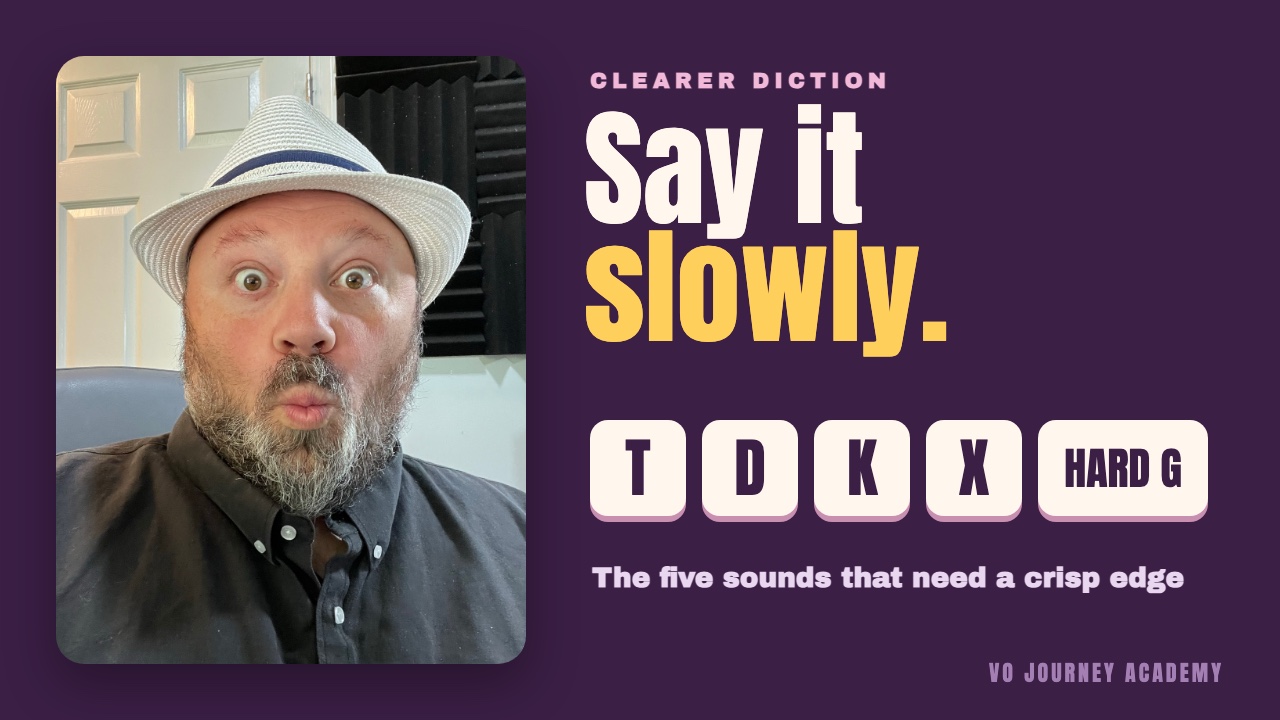
The hard consonants. Gabby's list is T, D, K, X and a hard G.
Not every sound has to be exaggerated. That's a common mistake. If those five have a crisp edge, your speech sounds clear even when the rest is relaxed.
| Sound | Example | What goes wrong when it's soft |
|---|---|---|
| T | "that" at the end of a line | The word sounds unfinished |
| D | "end", "need", "said" | It can turn into an N |
| K | "peck", "back", "think" | The word blurs into the next one |
| X | "next", "box", "six" | It collapses into an S |
| Hard G | "big", "dog", "game" | It drops out completely |
Why do soft word endings get cut off?
Because editing and processing think they're noise.
Gabby gave a good way to check yourself. If you use noise reduction or compression on your recordings, its job is to remove breaths and mouth noise. A soft T or D at the end of a word can look like noise to it, so it chops it out. If your endings keep disappearing in the edit, your diction is the first thing to look at, not the plugin.
How long does it take to improve your diction?
Months, and often years. Don't beat yourself up.
People get frustrated when they aren't good at this straight away. But you're changing habits you've had your whole life. Gabby spent her first five years in the business changing her speech pattern. She grew up in New York, in a part of the country with a strong accent. Today people can't tell where she's from by how she talks. She says that took a lot of hard work.
I've acted my whole life. I toured and did thousands of shows. But those lines were memorized. Reading someone else's words off a page and making them sound like mine was a different skill. I had to learn it over time, one realization at a time.
Not sure which step you're on? Our four-stage path shows you what to do next, from setting up your studio to getting booked.
See where to startWhat should you read out loud to practise?
Anything that isn't yours, and a lot of it.
Reading your own words is easy. You already know what you mean. Someone else's writing makes you work out the thought as you go. Our free script library has hundreds to choose from, sorted by genre.
Then listen to a lot of work in the genre you want. Each genre has its own unspoken rules. If you want to narrate audiobooks, listen to audiobooks. The free five-minute retail samples are enough when money is tight. For more structure, I wrote a simple plan for how to practise voice acting at home.
Can too much diction be a problem?
Yes. Over-enunciating sounds stiff and old-fashioned.
We see this a lot in audiobook auditions, often from people with a theatre background. On stage the sound has to reach the back row. In a booth it doesn't. Gabby says to let the microphone do its job. It picks up much more than you think.
Some people over-enunciate because they think it makes them sound smarter. It can backfire. Every word gets the same weight. The read turns staccato and stops flowing. Real speech doesn't work that way. Little connecting words like "and" and "the" run into the words around them. The important words get the weight.
Here's a tip from Gabby. Watch a film from thirty years ago, then one made this year. Listen to how differently the actors speak. Today's casting wants that newer, more relaxed sound. If you want help with that side of it, read how to sound conversational when you read a script.
Frequently asked questions
Can you do voice over with a lisp?
Often, yes. A lisp is about where your tongue sits in your mouth. Gabby says the fix is becoming aware of that placement, and a speech pathologist can teach you some good tricks in a short time.
A client wants me to match another narrator's cadence. How?
Copy the attitude and feeling, not the sound. Cadence is just the speed and rhythm. Notice where they breathe and where they break a line. Read alongside their recording, and if the rereads keep coming, ask the client for a directed audition.
Do I need to lose my accent to work in voice over?
Not always, since some jobs want a regional sound. But you should be able to turn it down when the script calls for a neutral read. Gabby's one-word sticky note trick works for this too.
Should I warm up before I record?
Yes. A cold mouth is a lazy mouth. A couple of minutes of slow tongue twisters before a session helps your word endings land. Here are five reasons to warm up before your voice over.
How many minutes a day should I practise diction?
A few minutes of slow tongue twisters as a warm-up, then real reading. The reading out loud is where it sticks. Daily beats long and rare.
What to do next
Pick one tongue twister. Say it slowly five times, over-pronouncing every word. Then read a short script at normal speed and listen back for the endings of your words. If you'd like a coach to hear it, watch a free class. You can also watch the whole conversation with Gabby on the live.
Get your reads heard every week
In VO Journey Academy you read live in class and get feedback on what you're doing with your voice. Gabby Nistico and our coaches will hear the things you can't hear yet.
See the plansGo out there and audition.
Anthony
Anthony Pica, founder of VO Journey Academy