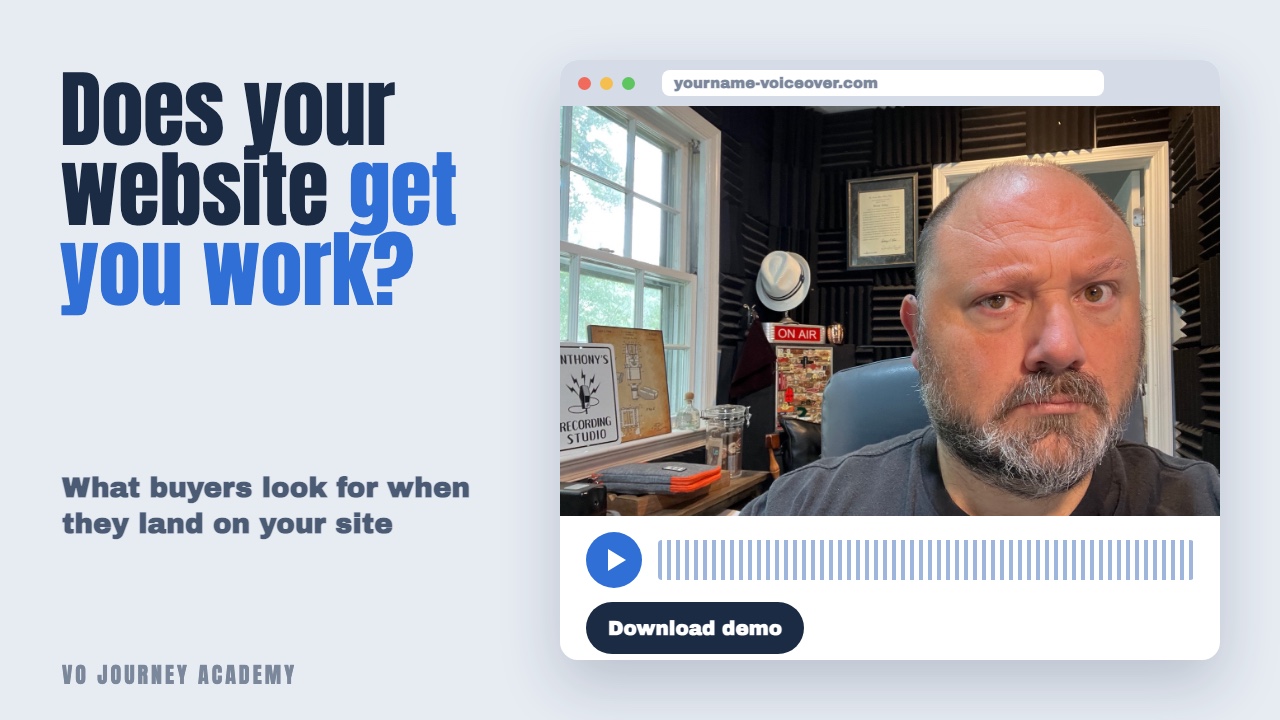
Yes. Buyers who hear about you will look you up, and your website is where they decide if you're worth hiring. But a website that only acts as a business card rarely brings in work. Make it the hub of your business, with samples buyers can download, a clear idea of who you're for, and a way to stay in touch with people who aren't ready to hire yet.
Two full VO Journey Academy class replays, free. Put in your name and email and they play straight away.
Watch the free classesWebsites came up on an Open Forum Friday with Gabby Nistico, and we ended up talking about them for most of the hour. I've been frustrated with voice actor websites since 2018, starting with my own. So this one is personal.
- You need a website, but a business card site won't bring in work.
- Make your site the hub of your business, not a placeholder.
- Design is the small part. How the site works matters more.
- There's no such thing as a beginner website. Aim high from day one.
- Let buyers download your samples, because they share them with clients.
- Most visitors won't hire you today, so give them a way to stay in touch.
Why do most voice actor websites bring in no work?
Because they're built as a business card, not a business.
For years my websites brought in nothing. No business came through them at all. The only time they did anything was when someone met me somewhere and looked me up. Then I was embarrassed by what they found. They probably took one look and decided not to work with me.
That's the first question to ask about your site. Does it make people more interested in you, or less? A lot of voice actors have a site because they feel they should. They get it built, and then nothing happens.
What does it mean to make your website the hub?
Everything in your business points back to it, and it does real work for you.
Your demos and samples live there, along with the way buyers get in touch. Everything else you do online can send people to it. When someone lands on it, it should help them hire you, not just tell them you exist.
| What the buyer needs | Business card site | Hub site |
|---|---|---|
| Hear you fast | One demo, if they can find it | Demos and samples sorted by type of work |
| Share you with a client | Play only | Samples they can download |
| Get in touch | An email address somewhere | A clear contact button on every page |
| Come back later | Nothing to bring them back | A sign-up so you can follow up |
| Find you on Google | One page with little to index | A page for each kind of work you do |
That takes more work than a one-page site. Not every voice actor wants to do that work, and that's fine. But if you want your site to bring in jobs, it has to do more than sit there.
Does design or function matter more?
Function, by a long way.
Gabby made this point well. Design and function are two different things, and people mix them up when they use a template. Design is the pretty part, the veneer. Function is how the site works. It covers how buyers move through it and what happens behind the scenes. Map that out first. Design is only a small part of running a site.
“Design is only a very, very small part of maintaining a site.”
Gabby Nistico, VO Journey Academy Live, 23 Oct 2026
Is there such a thing as a beginner website?
No. Gabby doesn't like the idea, and neither do I.
A viewer said he'd learned there are tiers of websites, with a basic one to start with. Gabby said people fall into the same trap with demos. They think there's a beginner version of everything, from microphones to demos to websites. Calling something a beginner version undersells your business before anyone hears you. Your materials should compete at the top level from the start.
That doesn't mean you need a huge site. My voice over site has about fifteen pages, which is a lot for one voice actor. Gabby's has about five. It means every page you do have should be good.
What do buyers want when they land on your site?
To hear your work quickly and know if you fit their job.
Think about the buyer, not yourself. Who are you trying to reach? What are they looking for when they arrive? A lot of voice actor sites are built the way the voice actor wants to see them, not the way a buyer wants to use them.
Gabby sees another problem. Many people over forty didn't grow up building websites. They look for help, and the help they find often isn't built for voice actors. A site for a plumber or a café works differently from one for a voice actor.
Not sure which step you're on? Our four-stage path shows you what to do next, from setting up your studio to getting booked.
See where to startShould buyers be able to download your samples?
Yes. It's one of the biggest complaints buyers have.
Some voice actors don't want people downloading their demos because they're worried about copying. I understand that. But a lot of the people who hire us aren't the end client. They're studios and producers putting together options for their own client. If they can't download your sample, they can't share it. Then you're out of the running.
Voices.com once put demo downloads behind a paywall for buyers. Buyers were upset, because they needed the files to pass along to their clients. Learn from that. If a buyer can't easily download your demo, make it easy.
How do you turn visitors into clients?
Give them a way to stay in touch, because most won't hire you today.
You can spend a lot of time getting people to your site. Then what happens when they arrive? The chance that a buyer is ready to hire you that same day is low. It might take them a week or two. Meanwhile they're gathering samples for a client.
So capture something. A simple sign-up or contact form lets you follow up with them later. Without one, they leave without a trace.
Is a one-page website enough?
Usually not, if you want people to find you on Google.
Long scrolling one-page sites became popular because they work on phones. The problem is that one page doesn't give search engines much to go on. Gabby says your findability on Google is everything, and more pages give you more chances to show up. A page for each type of work you do is a good place to start.
Frequently asked questions
Should I use a site builder or build from scratch?
Site builders are fine places to start. The catch is that they can only do what they were built to do. I moved to building from scratch because I kept having ideas the builders couldn't handle. My own site at anthonypicavo.com is built that way.
What should be on a voice actor website?
Start with your demos and samples sorted by type of work. Add a short bio and an easy way to contact you. Make the samples downloadable and add a sign-up form.
Do I need a website before I have a demo?
Get the demo first. A site with nothing to hear won't help you. Start with how to make your first voiceover demo.
How do I get buyers to my site in the first place?
Point everything at it. Every email and social profile should link back. Reaching out to buyers directly works too, and I wrote about how to start voice over with no clients.
What to do next
Open your own website on your phone and pretend you're a busy producer. Can you hear a sample in ten seconds? Try downloading it, then find the contact button. Fix the first thing that slows you down. If you'd like help with the business side of voice over, watch a free class. You can also watch the whole conversation with Gabby on the live.
Build a voice over business, not just a site
VO Journey Academy members get live classes every week on acting and on marketing yourself, with Gabby Nistico and our coaches answering questions live.
See the plansGo out there and audition.
Anthony
Anthony Pica, founder of VO Journey Academy