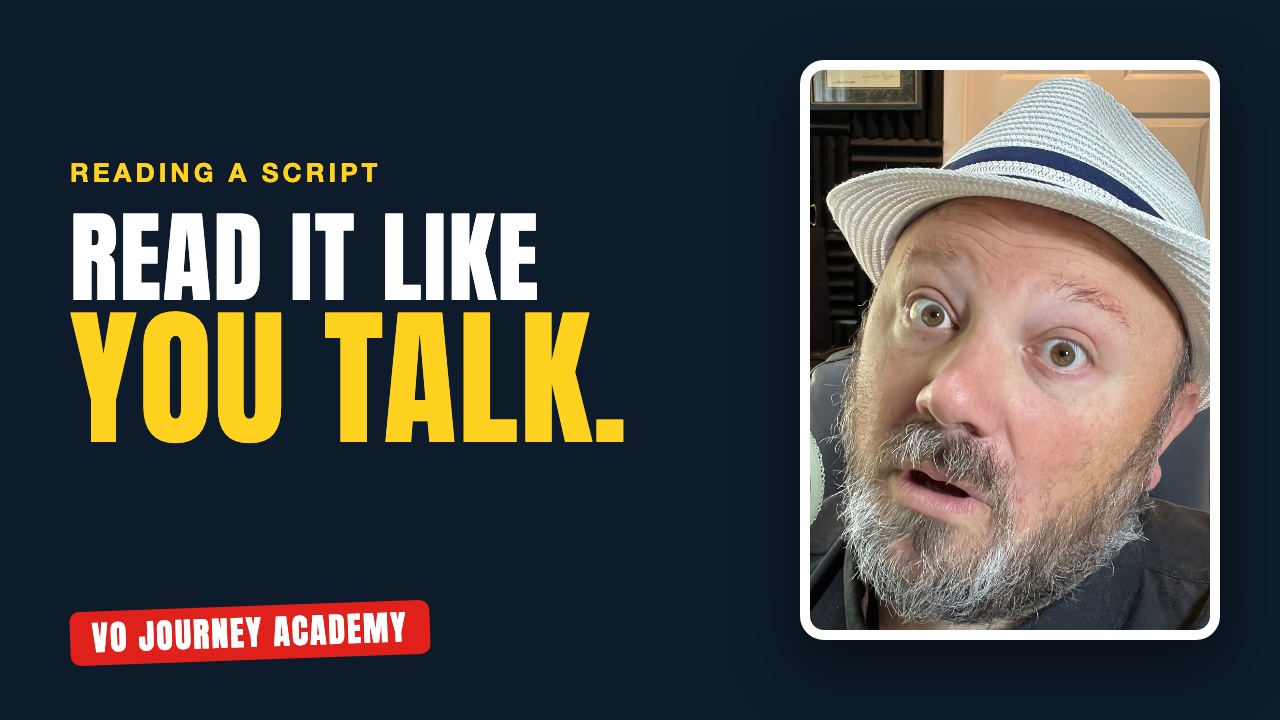
To sound conversational, don't just slow down. Use pauses and change your speed the way people really talk, and put the weight on one idea per sentence. If you emphasize every word, nothing sounds important.
Practice these on real narration and commercial scripts from our free library of over 3,000.
Get the free scriptsI was working with a student recently on their delivery. Absolutely great student, great person. And it got me thinking about something I see all the time. As voice actors, we get into a comfortable space when we voice act, and we're not always sure if our acting is losing us business or getting us business. The first thing we look at is our voice, because the product is our voice. Audio quality and your brand matter a lot. But this post is about your acting, and more specifically, sounding like a real person talking when you read a script.
- "Slow down" is fine advice, but it's only part of the advice.
- Going slow often feels boring. People then pile on pitch and drama until the read turns into a presentation.
- Pauses and changes of speed sound more natural than one slow pace.
- There's usually one idea in a sentence. Emphasize that, not every word.
- Long reads like audiobooks need lighter, faster stretches so the listener gets a break.
- If auditions aren't booking, change the read, not just the number you send.
Isn't "slow down" the right advice?
It's fine advice. It's only part of the advice.
People say it because when you talk faster, it gets harder to say words clearly. They get jumbled up, and it sounds like you're stumbling. There's some nervousness there, which is understood. So the voice actor slows down, and all of a sudden they read better. They don't miss as many words, and it feels right. You want to feel comfortable narrating, for goodness sake. It's like the stars align, and you think you've arrived.
However, nothing changes when it comes to getting work. You don't get booked, and you probably get no feedback, because we don't get feedback when we audition. Even if we did, a lot of times they'd have no idea what to tell us. So we figure we fixed the acting and it must be something else.
What does going slow do to a read?
It usually makes it boring, and then people overcorrect.
Everyone has to sound conversational, no matter what you're doing. Even video games, which are heightened life, still have to sound real. When you go slower, you recognize intuitively that it's boring. So you start adding things. More pitch variation, more drama, things that make you sound less like you're talking to somebody. It turns into a presentation that feels wholly unnatural.
I know you know what I'm talking about. Some people are completely natural when they talk to you. But when they get in front of the microphone, they turn into something completely different.
“I used to call it the crap between here and the microphone. The mile of crap that's just right here.”
Anthony Pica, VO Journey Academy Live, 14 Sep 2026
If you slow down, it still has to sound like a natural way for you to speak. It must keep natural speech patterns (characters that push that boundary are the exception).
What should I do instead of just slowing down?
Use pauses, and use speed in both directions.
Pauses are very underrated. Not everywhere. If you've got a 15-second commercial with 25 seconds of copy, there's no time to pause. But in general, a pause timed right, after the right moment, has a powerful effect. You can pause before a word or after it. You can also speed up and slow down. We're always talking about slowing down, but you can do both, and that takes away a lot of the awkwardness. Sometimes we talk fast. Sometimes we talk slow.
| Compare | Just slowing down | Conversational |
|---|---|---|
| Pace | One slow speed the whole way | Faster on background information, slower on the moment that matters |
| Pauses | Even gaps everywhere | Placed before or after the word that lands |
| Emphasis | Four or five words pushed in every sentence | One idea per sentence |
| How it feels to listen | Like a presentation | Like someone talking to you |
If you're worried you're too slow, judge it yourself. Are you bored listening back? And when people tell me they don't like listening to their voice, I don't think that's true. You hear your voice every single day, in your head. I think we don't like how we're presenting sometimes. When we do a good read, we don't say it was great but we still hate the way we talk. So trust yourself. You can tell if it's boring.
Read live and get a note from a working coach, four nights on Zoom. Free.
Save my free seatHow do I stop emphasizing everything?
Try the one-word exercise. It's one I used to love doing in class.
Take a sentence and underline one word. Say the whole sentence the same way except for that word, and change just that word, say by raising the pitch and volume. Try it with "The dog ran home." Put the weight on "the," then on "dog," then on "ran," then on "home." Each one sounds different and means something different, even though the rest stays the same.
A lot of times we read sentences with four or five or six words we're trying to make interesting. That's not how we talk. There's usually one idea in a sentence. If every word sounds important, nothing does. It's very weird to listen to.
Why does this matter more on audiobooks?
Because listeners get tired.
We talk in a lot of off-the-cuff, background information. Most commercials are written that way too. It's information that's needed, but it doesn't move us, so it's usually spoken faster with less weight. On a long read, people get exhausted if every sentence has incredible weight and depth. Shakespeare knew this. That's why there are those odd comedic scenes in the middle of his tragedies. The audience needed a break, and those lighter stretches give your listener one.
What if my auditions still aren't booking?
Change the read, not just the volume of auditions.
A lot of voice actors do more of the same instead of changing their acting. I got to a point where nobody responded to any audition I sent. I was so frustrated I said some crazy stuff in auditions, like asking if anyone was actually listening. I'm not telling you to do that. But it showed me it was up to me to push my acting. So I tried different things. I'd speed up and slow down and make big pitch changes, and I sent them. Sending it is the key. More on the numbers side in How Many Auditions Does It Take to Book a Voice Over Job.
Also read different genres differently. A nonfiction history audiobook and a gory first-person video game audition are completely different, and your acting has to change.
Frequently asked questions
Is reading slowly bad for voice over?
No, but slow on its own usually sounds unnatural. Keep natural speech patterns and mix in pauses and changes of speed.
How do I know if my read sounds natural?
Listen back and ask if you're bored. Then read it two different ways and check you can hear the difference. Hearing it is the most important part.
What's a good exercise for sounding conversational?
Pick one sentence and put the weight on a different word each time, keeping the rest the same. "The dog ran home" works.
Should every genre be read the same way?
No. Narration needs a different read from commercials or games. Change something for each one.
How long does it take to hear the difference?
It takes time and a lot of recording. Push yourself to extremes sometimes. No one's in the booth with you, and you don't have to share the file.
What to do next
Grab a page from the audiobook section of the free scripts library and read it twice. Do it your normal way first, then with pauses and speed changes. Then do the one-word exercise on a single sentence. To warm up first, try our Voice Acting Exercises or 25 Tongue Twisters. Rubber baby buggy bumpers, anyone.
Get notes on your read every week
It's hard to hear this stuff on your own. Gabby Nistico teaches Acting live on Monday nights, and Launch Pad members read for Angela Ohlfest every Thursday. Launch Pad is $37 a month.
Start with Launch PadGo out there and audition.
Anthony
Go out there and audition.
Anthony
Anthony Pica, founder of VO Journey Academy